
Will AI replace human language teachers?

« Il n’y aura plus de profs de langues avec l’IA »
Are you sure?

« Mon rêve, c’est d’échanger avec ChatGPT »
« Je voudrais avoir un super niveau de compréhension orale en italien, tout en m’entraînant avec des enregistrements confectionnés par un algorithme »
« La culture des Large Language Models, ça me passionne »
—
« Mon rêve, c’est de visiter New York et d’échanger avec les locaux »
« J’aimerais améliorer mon italien pour mieux comprendre l’opéra, j’adore la musique classique »
« La culture japonaise, ça me passionne »

Language is not a static collection of grammar rules and vocabulary.
Language is not a closed system like chess, and words are not vectors in a vector space.
A neutral network is an extremely crude approximation of a human brain, which does not actually account for the incredible complexity (including many unknowns) of how that organ actually functions.
Using statistics to predict the most likely next word in a sentence, based on terabytes of data, is not “writing,” nor is it “speech.”
Une langue est un lieu de connexion humaine et d’émotion.
Une langue contient l’histoire d’un peuple.
Une langue, c’est le site où se construisent une identité et une culture — des terrains subjectifs, et qui évoluent sans cesse.
Et les vrais experts dans ces domaines ?
Les êtres humains.

AI does have its use cases, including (in certain judiciously chosen applications) in language-learning.
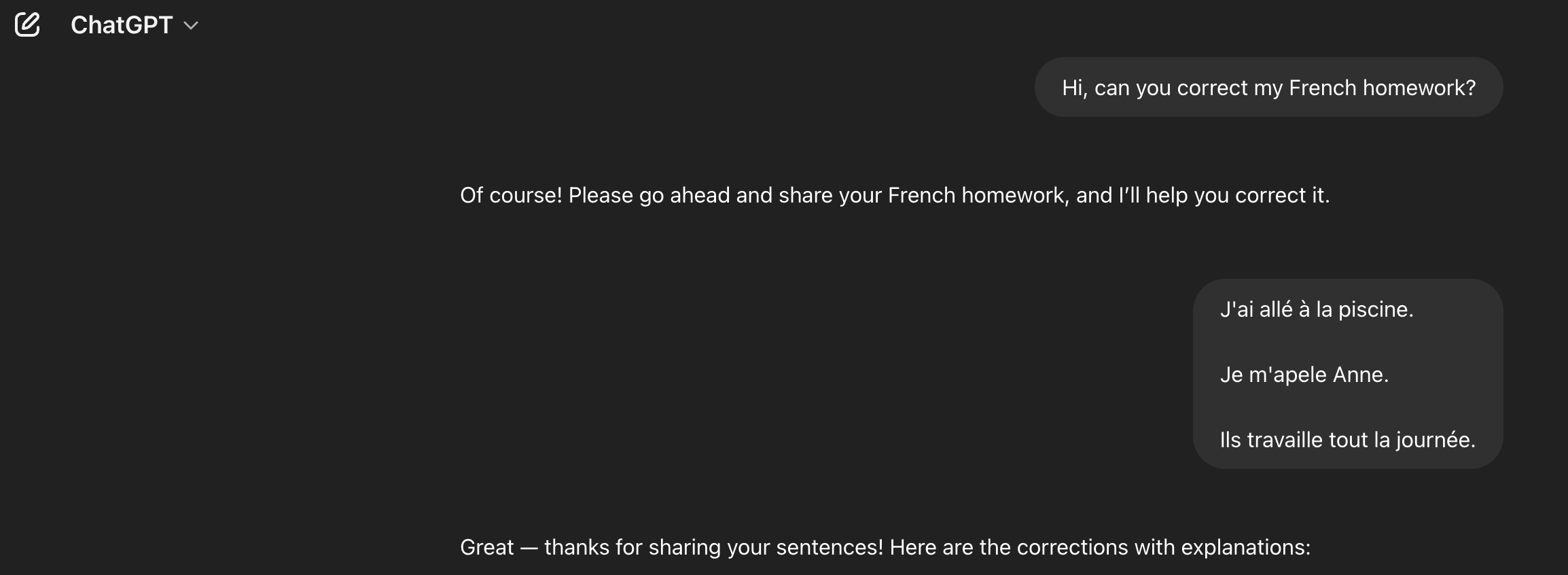
And personally, I am very excited about the potential of AI tools for medical imaging and diagnostics.
But using AI as a wholesale replacement for human teachers or language coaches?
Yeah… Contactez-moi quand vous trouvez quelqu’un qui dit,
« Je rêve d’échanger avec chatGPT. »
Today’s English lesson: Some suggestions for further reading
I invite you to revel in the sheer joy of human literature and read one of the most well-known and studied poems in the English language: “The Red Wheelbarrow” by William Carlos Williams. This is a classic in classrooms across the United States, and reading it for the first time is one of my most vivid memories from middle school.
You may also enjoy this thought-provoking reader’s guide to “The Red Wheelbarrow.”
Want to continue learning and thinking about AI? You may like this interview with Noam Chomsky, one of the founders of the field of cognitive science, the world’s preeminent linguist, author of 150+ books, retired MIT professor, and one of the most respected public intellectuals of all time whose influence has been compared to Galileo, Newton, and Descartes.
Whenever you’re feeling ready, here's how I can help:
1. English Coaching: My signature offer, 12 private sessions that will help you feel more confident and make real progress.
This is a bespoke (sur mesure), immersive learning experience, unlike any English class you've ever had before…
Et d’une bien meilleure qualité que ce qui est proposé par les outils d’IA ;)
2. Subscribe to this newsletter, if you haven't already, to get posts just like this delivered straight to your inbox.
You can also check out the archive to read past newsletters!
3. Send me a DM on LinkedIn with your English questions.
And there's no such thing as a silly question :)
Did you find a mistake in this newsletter?
Ça m’étonnerait pas, car c’est un être humain qui l’a rédigée et non une intelligence artificielle.
Comme je l’explique ici, la communication est ce qui compte pour moi.
If I’ve shared something useful or thought-provoking, then I have achieved my goal.
With that being said, you are welcome to edit my French … but only if you write and explain the rationale in English ;) and be nice!